
Why part of your attention stays behind when you switch tasks — and how to clear it before you rest.
You close the budget file and open your calendar. Physically, you switched. Mentally, part of your attention may still be on numbers you did not finish. Sophie Leroy's published research introduced the term "attention residue" for this pattern: moving to a new task before fully disengaging from the previous one may reduce performance on the new task because attention remains partly allocated elsewhere.
Source: Leroy, S. (2009). Why is it so hard to do my work? The challenge of attention residue when switching between work tasks. Organizational Behavior and Human Decision Processes. Study findings describe laboratory and field conditions; everyday results vary.
Residue is not daydreaming. It is active background processing of incomplete goals. The brain treats open loops as live priorities. Until you signal closure — or complete a meaningful sub-step — those loops consume bandwidth you thought you freed by standing up from the chair.
This matters for breaks because many people pause mid-paragraph, mid-formula, or mid-conversation thread. They walk away hoping rest will reset them. Instead, the unfinished piece follows like a quiet radio station you cannot quite tune out. The break refreshes muscles but not the cognitive channel still tuned to the old task.
Stopping during deep focus without a checkpoint creates the strongest residue. The brain expected continuation and received ambiguity instead.
Notifications that pull you from one task to another stack residue from both sides — the interrupted task and the rushed response.
Emotionally loaded or urgent unfinished items occupy more residue because the brain tags them as important open goals.
An email you read but did not answer, or a meeting tension left unspoken, can residue as strongly as technical work.
Leroy's experiments showed measurable performance drops on a new task when the prior task was left without a satisfying stopping point. The effect weakens when people reach a natural sub-goal — a completed section, a sent reply, a saved draft with a clear next marker. Breaks taken after such checkpoints feel lighter because the brain receives evidence that progress is parked safely.
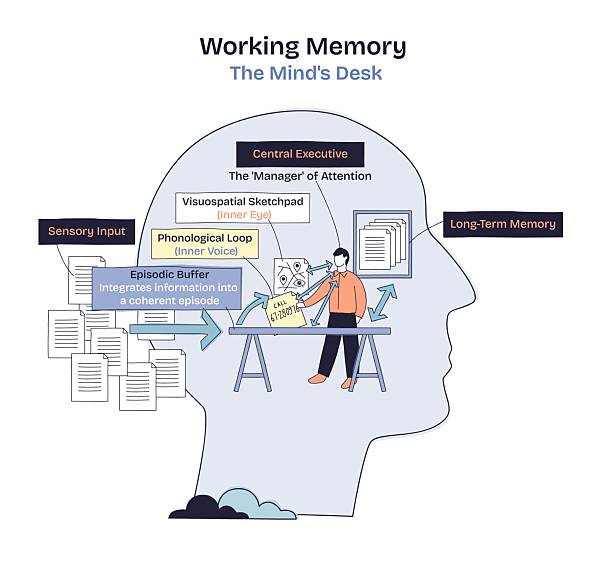
Before leaving, note the single first step for your return: "Open row 14 and verify totals." This externalises the loop so working memory can release it.
Finish one small bounded piece — a paragraph, a formula block, a filed document — so the brain registers partial completion.
After closing files, sit without input. Let the context fade before standing. Rushing to the break preserves the mental screenshot.
Close the laptop lid, push the chair back, or leave the room. Physical boundaries reinforce psychological task boundaries.

Even a perfect low-stimulation break fails if residue remains high. You might sit quietly yet mentally rehearse an unfinished sentence. The body rests while the task tab stays open internally. Combining closure with appropriate rest multiplies the benefit.
Teams can reduce collective residue by ending meetings with explicit next steps and owners. Ambiguous endings spawn afternoon drift as participants carry different incomplete versions of what was decided. A thirty-second recap — who does what by when — lowers group residue dramatically.
Personal practice mirrors team practice. Treat breaks as bookends, not escape hatches. The minute before you leave is as important as the five minutes away. That minute buys cleaner attention when you return, which means less time re-reading the same paragraph and more actual forward motion.
Start by noticing your worst residue triggers. For many people it is email left in "read but not handled" state, or creative work stopped at an awkward midpoint. Once identified, build habits at those specific points — templates for quick replies, outline headings before pausing writing, colour flags in spreadsheets marking restart cells.
Batch similar tasks to reduce switch count. Each switch risks residue; fewer switches mean fewer fragments floating in background. When switches are necessary, use a consistent shutdown phrase: "Stopping here. Next: [action]." Saying it aloud sounds odd once; doing it daily trains a reliable off-ramp.
Pair this with the freeze technique on our homepage — writing one action and symbolically locking it away tells the nervous system the file is saved. Residue drops because the brain trusts the external note more than memory alone. Over weeks, returns feel faster not because you got tougher, but because you stopped leaving doors open behind you.

Avoid rapid task-hopping when fatigued — errors and residue both increase under exhaustion.
Use notebooks or apps to offload open loops rather than holding them in memory during rest.
Unresolved work carried into evening can affect rest quality — closure rituals help separate work from recovery time.
| Date | Event | Location |
|---|---|---|
| 10 Sep 2026 | Cognitive Closure Techniques | Vaasa, Finland |
| 15 Jul 2026 | Focus & Flow Workshop | Vaasa, Finland |
Duration varies by person and task. Without closure, residue may persist for some time. A clear next-action note is one technique some readers use; we do not promise a fixed recovery time.
This site discusses attention patterns described in research literature, not clinical outcomes. Frequent unfinished switching may reduce moment-to-moment performance and increase perceived stress for some workers.
Calm, familiar music during a transition may help some people. Lyric-heavy or novel tracks can add stimulation — match audio to your recovery goal.